
If you don't know what a word means, you'll definitely find it here.
An inspection intended to establish the overall level of safety of the equipment, foundations and play surfaces (ref. UNI EN 1176-1:2024 point 3.28). The annual main inspection is carried out to establish the overall level of safety of the equipment, foundations and surfaces, for example compliance with the relevant part(s) of EN 1176, including any modifications made following the evaluation of safety measures, the effects of weathering, the presence of deterioration or corrosion, and any change in the level of safety of the equipment following repairs carried out or the addition of components. Particular attention should be paid to "lifetime sealed" parts. This inspection of the equipment should be carried out by competent persons strictly following the manufacturer's instructions. (ref. UNI EN 1176-7:2020 point 6.2)
Equipment in which only vertical movement can occur. (ref. UNI EN 1176-6:2019 point 3.2)
A device intended to prevent the user from falling and passing underneath.
The Minimum Environmental Criteria (CAM) are the environmental and ecological requirements defined by the Ministry of the Environment aimed at guiding Public Administrations towards a rationalisation of consumption and procurement, providing guidance for identifying better design solutions, products or services from an environmental perspective. Green purchasing must take into account the entire life cycle of a product or service, from its disposal, to its availability on the market, to the transparency of the production chain. https://www.holzhof.com/criteri-ambientali-minimi
Chains for playground equipment must comply with the dimensional requirements of Table 2 of EN 818-2:1996+A1:2008, or Table 2 of EN 818-3:1999+A1:2008 as a minimum and, when tested in accordance with point D.5, must comply with one of the following requirements:
Equipment should be constructed so as not to create hazardous situations that could cause clothing entrapment, including the following: a) V-shaped spaces or openings in which part of a garment may become trapped while the user makes or is about to make a forced movement; b) protrusions; and c) pins and rotating parts (e.g. roundabouts). Slides or poles must be constructed so that openings positioned within the free space do not trap the test hook when tested in accordance with point D.3. Roofs must be constructed so as not to trap the test hook when tested in accordance with point D.3. Pins and rotating parts must be constructed to prevent entrapment of clothing or hair. (ref. UNI EN 1176-1:2024 point 4.2.7.3)
A slide whose access to the starting zone is only possible by passing through another piece of equipment or parts of equipment - (ref. UNI EN 1176-3:2018 point 3.3)
A group of individually and flexibly suspended seats attached to load-bearing cross beams arranged around a central axis (a central point), generally six in number - (ref. UNI EN 1176-2:2019 point 3.5)
A seat with a larger body support intended for younger or less able users, generally designed to prevent the user from slipping through the structural elements surrounding the seat. The minimum distance from the ground in the stationary position must be 350 mm (ref. UNI EN 1176-2:2019 point 3.12)
Maximum free fall height for which a surface provides an acceptable level of impact attenuation.
Equipment that requires only basic ability to access and that allows users to move freely and quickly on/within the equipment, without further consideration of the use of hands and feet. The following is an example of three possible means of access in order of ease:
EN 71 is a European standard governing the safety requirements of toys and establishes the safety requirements and test methods for toys intended for children up to 14 years of age. These toys are classified as "domestic use" and should not be installed in public parks (municipal parks, parks located in campsites or hotels, beach parks, etc.) where there is usually a large number of children. The standard has been adopted and published in Italy by the Italian National Standards Body under the name UNI EN 71. The UNI EN 71 series of standards requires that toys be tested to verify that the materials they are made of and their coatings do not release toxic substances. Toys must not have sharp edges, pointed tips, or loose parts that could harm children. Another requirement carefully evaluated by European standards is flammability. UNI standards prohibit the use of highly flammable materials.
Hazard represented by the situation in which a body or part of a body, or a garment, may become trapped. (ref. UNI EN 1176-1:2024 point 3.18)
The equipment must be marked in a legible, permanent manner and in a position visible from the ground with at least the following information: a) the name and address of the manufacturer or authorised representative; b) the equipment reference and year of manufacture; and c) the number and date of the relevant European standard, i.e. EN 1176-1:2017 (ref. UNI EN 1176-1:2024 point 7.1)
Beneath all playground equipment with a free fall height greater than 600 mm and/or beneath equipment that causes forced movement on the user's body (e.g. swings, slides, rocking equipment, zip wires, roundabouts, etc.), there must be an impact-absorbing surface covering the entire impact area. The critical fall height of the surface must be equal to or greater than the free fall height of the equipment. Impact-absorbing materials should be subject to adequate maintenance. Failure to maintain such surfaces leads to a considerable reduction in their impact-absorbing properties.
Unless otherwise specified, the extent of the fall space must be at least 1,500 mm around the elevated parts of the equipment, measured horizontally and extending from the vertical projection plane below the equipment. The fall space must increase for free fall heights greater than 1,500 mm together with the extension of the impact area. This requirement may vary in some cases, for example, be increased in the case of forced movements or reduced in the case of equipment installed on or against a wall or of completely enclosed equipment. In most cases the fall spaces, including the impact areas, may overlap. An overlap of the fall space should not occur where there is forced movement, unless specified elsewhere in this standard. When two elements with different fall heights are located together, the larger of the two impact areas shall take precedence. (ref. UNI EN 1176-1:2024 point 4.2.8.2.5)
The fall space must correspond to the impact area extended to a height equivalent to the free fall height (D) see figure 10. For all swings, the extension of the impact area must be calculated considering the point A reached horizontally from the centre of the swing seat, when the latter has travelled an arc of 60° (which can be calculated by multiplying 0.867 x the length of the suspension element, (h 2) and adding a fixed distance S or C (depending on the surface construction). In the case where the impact area is level with the surrounding surface (generally synthetic material), the additional fixed length B must be 1.75 m, and in the case of a recessed surface (generally loose granular material), the additional fixed length C must be 2.25 m (see figure 10). Furthermore, for an impact area that is level with the surrounding surface, where B is 1.75 m, an additional area of 0.5 m in length, in the direction of swing, must be provided that is free from obstacles. The extent of the impact-absorbing surface should be based on the intended use of the swing. The fall spaces of swing seats fixed to different load-bearing swing structures must not overlap. The fall space may overlap the free space when swing seats are fixed to the same load-bearing structure, provided they comply with point 4.4.1 of UNI EN 1176-2:2019. When swings are placed next to other play equipment, the fall space of the swing and the fall space of the other play equipment must not overlap. (ref. UNI EN 1176-2:2019 point 4.10.2.1)
In some cases, such as a roundabout that imparts a horizontal speed to the user, the impact area may be extended to provide adequate protection against fall injuries. When determining the impact area, the possible movements of the equipment and the user must be taken into account.
Space, located inside, above or around the equipment, that may be occupied by a user falling from an elevated part of the equipment. Note: The fall space begins at the free fall height (ref. UNI EN 1176-1:2024 point 3.8)
Concerns openings in which fingers may become trapped while the rest of the body moves or continues forced movement, for example of sliding or swinging, or variable openings (excluding chains). Openings within the free space in which the user is engaged in a forced movement, and/or holes whose lower edge is more than 1,000 mm above the potential impact area, are tested in accordance with point D.4. Openings must comply with one of the following requirements: the 8 mm finger-shaped rod must not pass through the minimum cross-sectional opening and the profile of the opening must be such that the rod cannot be blocked in any position when set in motion as described in point D.4.2; or if the 8 mm finger-shaped rod passes through the opening, the 25 mm finger-shaped rod must also pass through the opening, provided the opening does not allow access to another finger entrapment zone. Spaces whose dimensions change during use of the equipment must have a minimum dimension in all positions of 12 mm. Slots in individual pieces of wood must not be considered as finger entrapment where the opening decreases towards the centre of the wooden part. (ref. UNI EN 1176-1:2024 point 4.2.7.6)
A seat without a backrest and without side guards. The minimum distance from the ground for single-use swings in the stationary position must be 350 mm. (ref. UNI EN 1176-2:2019 point 3.11)
Equipment in which both vertical and horizontal movement (multidirectional) occurs that may result in a floating motion. (ref. UNI EN 1176-6:2019 point 3.6)
Equipment should be constructed so as not to create the following hazardous situations that could cause entrapment: a) rigid completely circumscribed (enclosed) openings made in surfaces on which children can run or climb; and b) footholds and handholds, etc. protruding from these surfaces. Surfaces designed for running/walking must not have any space that could trap the foot or leg. Spaces in the principal direction of travel must not be greater than 30 mm when measured across the direction of travel. This requirement does not apply to surfaces with an inclination greater than 38° relative to the horizontal plane. (ref. UNI EN 1176-1:2024 point 4.2.7.5)
Movement of the user caused by the equipment (e.g. swinging, sliding, roundabout rotation, etc.) that once started cannot be fully controlled by the user - (ref. UNI EN 1176-1:2024 point 3.34)
Foundations must be designed so as not to constitute a hazard (tripping, impact). In surfacing with loose, mobile material (e.g. sand), foundations must be installed or laid in accordance with one of the following methods:
Maximum vertical distance between the designated body support and the underlying impact area.
Space located inside, above or around the equipment that may be occupied by a user performing a movement induced by the equipment (forced movement) - (ref. UNI EN 1176-1:2024 point 3.6)
A slide separate from any other part of equipment with its own means of access connecting the ground directly to the starting zone - (ref. UNI EN 1176-3:2018 point 3.6)
The Chain of Custody (CoC) certification guarantees the traceability of materials from FSC-certified forests. Thanks to this certification, an organisation can guarantee the origin of the timber used to make its products and thus demonstrate in a correct, transparent and controlled manner its active contribution to responsible forest management. Holding a valid FSC Chain of Custody certification is a necessary condition for being able to sell a product as certified. https://www.holzhof.com/fsc
A grip of the hand around the entire circumference of a support (ref. UNI EN 1176-1:2024 point 3.18). The cross-section of any support designed to be fully gripped to support the entire body weight must have a dimension between 16 mm and 45 mm in any direction, when measured passing through the centre - (ref. UNI EN 1176-1:2024 point 4.2.4.6)
An inspection, more detailed than the periodic visual inspection, intended to verify the functionality and stability of the equipment (ref. UNI EN 1176-1:2024 point 3.27). The operational inspection is a more detailed inspection to check the use and stability of the equipment, in particular to detect any wear. This inspection should be carried out at intervals of 1 to 3 months, or as indicated in the manufacturer's instructions. Particular attention should be paid to "lifetime sealed" parts (ref. UNI EN 1176-7:2020 point 6.2)
The manufacturer/supplier must provide instructions in the appropriate language(s) of the country in which the equipment is to be installed and used. The instructions must comply with the following: a) the instructions must be printed in a legible form and in simple language; b) illustrations should be used wherever possible; c) the instructions must include at least the following information: 1) details relating to the installation, use, inspection and maintenance of the equipment; 2) a point or note drawing the operator's attention to the need to increase inspections and maintenance if the equipment is subjected to intensive use and/or if the stability of the equipment is based on a single post; 3) the warning to pay attention to the specific hazards to children if installation or dismantling is incomplete or during maintenance. The manufacturer/supplier should provide purchasers, on request, with copies of test reports. (ref. UNI EN 1176-1:2024 point 6.1.1)
A seat with a large surface area intended for multiple users, generally nest or basket swing seats, swings with a single suspension point, tyre seats and rocking beds. For group swing seats, the minimum distance from the ground in the stationary position must be 400 mm. For group swing seats with a flexible lower part, the clearance from the ground must be a minimum of 400 mm measured from the underside of the rigid part of the seat in its most unfavourable position. In the case of "contact" swings with vertical tyres as seats, the clearance from the ground may be reduced to a minimum of 100 mm (ref. UNI EN 1176-2:2019 point 3.13)
An element intended to prevent the user from falling (ref. UNI EN 1176-1:2024 point 3.23). The height to the top of the guardrail must not be less than 600 mm and not more than 850 mm if measured from the surface of the platform, stairs or ramp (ref. UNI EN 1176-1:2024 point 4.2.4.3)
An element intended to help the user maintain balance. Handrails must not be less than 600 mm and not more than 850 mm above the position of the feet. Handrails must comply at least with the requirements for partial grip (designed to be partially grasped and having a width not greater than 60 mm). (ref. UNI EN 1176-1:2024 point 3.22)
Equipment must be constructed so that any openings do not create head and neck entrapment hazards, whether passage occurs head first or feet first. The hazardous situations in which this type of entrapment can occur include the following: - completely circumscribed openings with a lower edge more than 600 mm above the play surface, through which a user can slide either head first or feet first: Templates C or E must not pass through an opening unless the opening also allows the passage of the large head template D. - partially circumscribed or V-shaped openings with an entry situated 600 mm or more from the ground: detected using the "fish-shaped" template in accordance with point D.2.2. - other openings (e.g. shear or moving openings): non-rigid elements (e.g. ropes) must not overlap if, by doing so, they create openings that do not meet the requirements for completely circumscribed openings. Openings between the flexible parts of suspension bridges and any rigid lateral part must not be less than 230 mm in diameter under the most unfavourable load conditions. Both situations, with and without load, must be considered. (ref. UNI EN 1176-1:2024 point 4.2.7.2)
Suspended rigid beams are considered heavy when they have a mass of 25 kg or more. There must be a ground clearance of at least 400 mm below heavy suspended rigid beams. The ground clearance is measured as the distance between the lowest point of the lower edge of the heavy suspended rigid beam and the underlying surface. The heavy suspended rigid beam must be constructed so that all variations in the beam profile have a radius of at least 50 mm. The range of movement must not be greater than 300 mm and must not extend beyond the support uprights. The distance between the support uprights and the heavy suspended rigid beam must not be less than 230 mm throughout its entire range of movement. (ref. UNI EN 1176-1:2024 point 4.2.15)
Area that may be struck by a user after falling through the fall space.
Examples of materials commonly used for impact absorption are given in Table 4 with their respective maximum free fall heights, tested in accordance with EN 1177 and measured partly on-site and partly in the laboratory under different test conditions. (Impact-absorbing materials should be subject to adequate maintenance. Failure to maintain such surfaces leads to a considerable reduction in their impact-absorbing properties.) (ref. UNI EN 1176-1:2024 point 4.2.8.5.2)
Impact area surfaces intended to reduce the risk of injury in the event of a fall - (ref. UNI EN 1176-1:2024 point 3.4)
Together with the equipment, the manufacturer/supplier must provide a list of the delivered parts. The manufacturer/supplier must provide installation instructions for the correct assembly, mounting and positioning of the equipment. This information must include at least the following: a) the minimum space requirements and safety distances; b) identification of equipment and parts; c) the assembly sequence (assembly instructions and installation details); d) supplementary instructions if necessary, for example those relating to symbols appearing on parts; e) the need for any special tools, lifting devices, templates or other assembly aids, and any precautionary measures to be taken. Torque values should be indicated where necessary; f) the construction space required for the installation of the equipment element; g) the orientation, where necessary, with respect to sun and wind; h) details of the foundations required under normal conditions, ground anchorage and the design and location of the foundations (with a warning about the precautions that should be taken in abnormal conditions); i) foundation details and any specific provisions for their accessibility during inspection and maintenance; j) specific instructions where a particular ground configuration is required for safe operation, for example a fall height; k) the free fall height (for the purpose of impact-absorbing surfaces); l) the need for and details relating to the application of any paints or treatments; m) the removal of assembly aids prior to use of the equipment. Drawings and diagrams must clearly specify the main dimensions of the equipment and the relevant spaces, heights and areas required for installation. The manufacturer/supplier must provide the necessary details for the inspection of the playground equipment prior to its first use. (ref. UNI EN 1176-1:2024 point 6.1.3)
The UNI EN ISO 14001 standard defines an "Environmental Management System" as part of the company management system aimed at managing environmental aspects, meeting legislative compliance obligations, and addressing and evaluating risks and opportunities. The Environmental Management System is characterised by the development and implementation of an environmental policy and objectives that commit the organisation to full mandatory (legislative) and voluntary compliance. https://www.holzhof.com/iso-14001
UNI EN ISO 9001 is a voluntary standard aimed at the continuous and ongoing improvement of the company, with the objective of optimising the organisational structure. It represents a strategic choice for companies wishing to increase their production, reduce costs, become more competitive in the market and increase customer loyalty. https://www.holzhof.com/certificazione-iso9001
An access means consisting of rungs or steps on which a user can ascend or descend with the help of their hands - (ref. UNI EN 1176-1:2024 point 3.13). The distance between rungs or steps must comply with the requirements for head and neck entrapment. Rungs and steps must not rotate and must all be at the same distance. An equal distance is only required between rungs. It is not required between the highest rung and the platform or between the ground and the first rung. The requirement for equal distance does not apply to rope ladders. To allow the foot to rest correctly on the rung or step, there must be an unobstructed space at the rear of the ladder of at least 90 mm measured from the centre of the rung or step at 90° to the ladder. Rungs and steps must be horizontal with a tolerance of +/-3°. Ladders must be fitted with rungs and/or uprights or handrails complying with the requirements for full grip or partial grip. (ref. UNI EN 1176-1:2024 point 4.2.9.1)
Space required for safe use of the equipment, comprising the fall space, the free space and the space occupied by the equipment. (ref. UNI EN 1176-1:2024 point 3.9)
Equipment fixed so that the movement, primarily horizontal, is guided by several parallel axes and has a single direction (back and forth). (ref. UNI EN 1176-6:2019 point 3.5)
A grip of the hand around part of the circumference of a support (ref. UNI EN 1176-1:2024 point 3.17). The cross-section of any support designed to be partially gripped must have a width not greater than 60 mm (ref. UNI EN 1176-1:2024 point 4.2.4.7)
PEFC (Programme for Endorsement of Forest Certification schemes) is a Forest Certification that is based on compliance with the criteria and indicators defined at the Ministerial Conferences on the Protection of Forests in Europe (Helsinki 1993, Lisbon 1998). A certified company is able to demonstrate the Chain of Custody of the timber, guaranteeing the traceability of the certified raw material throughout the transformation process and unambiguously maintaining its origin from certified forests managed in a sustainable manner. https://www.holzhof.com/pefc
An inspection intended to identify obvious hazards that may be caused by normal use, vandalism or weather conditions (ref. UNI EN 1176-1:2024 point 3.26). The routine visual inspection enables the identification of obvious hazards that may result from vandalism, use or weather conditions, for example hazards such as broken parts or bottles. For highly frequented play areas or those subject to vandalism, a daily inspection of this type may be necessary. (ref. UNI EN 1176-7:2020 point 6.2)
An elevated surface on which one or more users can stand without the need for hand support. (ref. UNI EN 1176-1:2024 point 3.21)
The surface of a play area from which the use of the playground equipment begins and which includes at least the impact area - (ref. UNI EN 1176-1:2024 point 3.5)
A vertical or near-vertical tube down which users can slide - (ref. UNI EN 1176-1:2024 point 3.39). Poles accessed through a platform or other point must have a distance of at least 350 mm from the pole to the edge of the adjacent structure (ref. UNI EN 1176-1:2024 point 4.2.8.2.3)
When a new play area is completed or after significant modifications to equipment or surfaces, a post-installation inspection must be carried out by a competent person to assess the overall level of safety (Ref UNI EN 1176-7:2020 point 5.3). The level of competence that a person should have to carry out an inspection at a park may depend on several factors such as the size of the park, the type of equipment installed, individual training, and personal skills acquired through experience. An inspection at a small park, for example, could also be carried out by the park manager themselves, provided they have followed a specific training course on the subject, whereas for larger parks containing complex structures, it is advisable to request this service from an external inspector who, in addition to their personal training, has acquired a good level of field experience. The post-installation inspection is usually carried out before the play area is opened to the public and its purpose is to assess the equipment and its environment for the overall level of safety in the play area (ref UNI EN 1176-7:2020 point 6.1). It should be carried out by an "independent" person, i.e. by the park manager themselves, a qualified external inspector, or even by the supplying company, provided that the person performing the inspection service did not directly participate in the installation of the equipment being inspected. This is expressly stated in the reference standard UNI EN 1176-7:2020 at point 6.2.2: "…it must be carried out by a competent person who has not directly taken part in the installation and is not responsible for any corrective work or any costs." See also the code of conduct in CEN/TR 17207:2018 (in English). The definition of "competent person" given by the standard is that of a "person suitably trained and qualified on the basis of knowledge and practical experience to carry out the required tasks - (Ref UNI EN 1176-7:2020 point 3.3). Note 1: the levels of knowledge required for the different levels of inspector competence are indicated, for example, in point 5.1 of CEN/TR 17207:2018 and/or in national specifications. Note 2: a competent person may be a manager, an inspector, an employee of the manufacturer or others." In conclusion, based on what is stated in the standard, the person performing a post-installation/play equipment inspection must be a person who has attended specific training courses on the safety of play area equipment and surfaces and the interpretation of European Standard EN 1176; they should also have acquired suitable personal experience by having carried out multiple field inspections and thus achieved the appropriate level of "competence" as clarified above.
The manufacturer/supplier must provide safety information relating to installation prior to acceptance of the order, for example by means of a catalogue data sheet. This information must include at least the following, where relevant: the minimum space; surfacing requirements (including free fall height and extent of surfacing); foundation details and any specific provisions for their accessibility during inspection and maintenance; the overall dimensions of the largest part(s); the mass of the heaviest part/section in kilograms; guidance on the age group for which the equipment is intended; whether the equipment is intended exclusively for indoor use or under supervision; the availability of spare parts; the declaration of conformity to this European standard (ref. UNI EN 1176-1:2024 point 6.1.2)
An access means comprising an inclined surface on which a user can ascend or descend - (ref. UNI EN 1176-1:2024 point 3.15). Ramps must have a maximum inclination of 38° from the horizontal plane and must have a constant angle. For ramps leading to platforms up to 1 m in height, a guardrail may replace a balustrade, provided the distance below the guardrail is less than 600 mm. If guardrails are used, they must be provided from the start of the ramp. Ramps must be flat in the width direction with a tolerance of +/-3°. To reduce the risk of slipping, ramps intended to be used by all children must be fitted with devices to improve foot grip. (ref. UNI EN 1176-1:2024 point 4.2.9.3)
The "Plastica Seconda Vita" (Recycled Plastic) mark is a product environmental certification system dedicated to materials and manufactured goods obtained from the recovery of plastic waste. It is the first Italian and European mark dedicated to recycled plastics. It introduces the concept of "quality" in recycled plastics and the concept of "traceability" of recycled materials. This mark was created in response to the need to make goods made from recycled plastics more visible and easily identifiable to Public Administrations and/or companies with a predominantly public shareholding (GPP), as well as to large-scale retail distribution. For this reason, IPPR publishes the Register of materials and manufactured goods bearing the "Plastica Seconda Vita" mark each year. The activities for obtaining the PSV mark are carried out by IIP, the Italian Institute of Plastics, a leader in Italy in product certification for the plastics sector.
The text analyses the complex issue of bringing existing playgrounds into compliance with the UNI EN 1176:2017 standard, highlighting the regulatory gap and interpretative discrepancies between Italy and Germany.
Here is a structured summary of the key points:
In Italy, there is uncertainty about how to assess equipment complying with obsolete versions of the standard (1998, 2003, 2008). Although the standard is not retroactive, an inspector operating according to EN 1176:2017 faces a dilemma: the current standard does not provide instructions on how to handle pre-existing equipment. The author argues that the inspector must record non-conformities with respect to the latest edition, while specifying that the equipment was compliant at the time of construction.
Unlike Italy, Germany has adopted a supplement that allows old play equipment to be retained (even those compliant with pre-1998 DIN 7926) provided they pass specific tests:
The evolution of the standard has created paradoxical situations regarding fall height and damping materials:
The text concludes by referring to UNI EN 1176-7:2020, which requires the manager to consider both the manufacturer's information and the requirements of the current standard. The proposed solution is that the inspector should not limit themselves to a bureaucratic check, but should carry out a risk assessment (low, medium, high). It will then be up to the manager, informed about the original compliance and current risks, to decide whether to proceed with adaptation or replacement based on the cost/benefit ratio and the safety of users.
Robinia, also known as Pseudoacacia, is a plant originally from North America that was naturalised in Europe 400 years ago, where it has spread widely. Robinia timber is at the same time elastic, highly durable and resistant to sudden climatic changes (wet/dry). The colour of this wood is very variable and tends to darken with steaming; it lends itself well to machining, finishing and polishing. Robinia timber is extremely resistant to loading and bending, as well as extraordinarily resistant to dynamic loads. https://www.holzhof.com/robinia
The equipment must be designed to prevent entrapment between the equipment and the ground surface (see Table 1). This can be achieved by:
For Type 1, 2, 3 and 4 equipment, when measured from the perimeter of the equipment in its most extreme positions, the fall space must be a minimum of 1000 mm (see figure 9). When the equipment is intended to be used in a standing position, the fall space must be a minimum of 1,500 mm. For rocking equipment of type 2, 3 and 4, the impact area must have a critical fall height of at least 600 mm. (ref. UNI EN 1176-6:2019 point 4.10)
These are suspended ropes that are attached to the structure at both ends. For a rope fixed at both ends, generally a climbing rope not forming part of a larger net structure, it must not be possible to form a loop in the rope wide enough to allow passage of a template C (torso 89x157 mm) or template E (small head diam. 130 mm). This requirement is intended to eliminate the risk of strangulation. The rope diameter must meet the requirements for full grip indicated in point 4.2.4.6 (dimension between 16 and 45 mm). Ropes with sufficient roughness allow a good full grip. This can be achieved, for example, by using outer strands with a diameter of at least 6 mm. When a rope fixed at both ends is used together with another element, care must be taken not to create head and neck entrapment situations (e.g. a climbing rope fixed to access a ramp). (ref. UNI EN 1176-1:2024 point 4.2.12.2)
These are suspended ropes that are attached to the structure at one end only. For suspended ropes between 1 m and 2 m in length, the distance between ropes fixed at one end and fixed equipment must not be less than 600 mm, and the distance between ropes fixed at one end and swinging equipment must not be less than 900 mm. Ropes fixed at one end must not be associated with swings in the same zone.
Playground equipment whose primary function is to rotate around a central axis (ref. UNI EN 1176-5:2019 point 3.1). Roundabouts are regulated by UNI EN 1176-5:2019 and are distinguished into several types.
The types of roundabouts that have free space requirements are set out in Table 1. The horizontal extent of the free space (see Table 1) must be equal to the extent of the impact area. The height of the free space must be as indicated in point 4.2.8.2.3 of EN 1176-1:2017. When roundabouts are installed in proximity to other playground equipment, the impact area of type A, B, C and E roundabouts must not overlap with the impact area of other equipment. (ref. UNI EN 1176-5:2019 point 4.3)
The types of roundabouts that have free space requirements are set out in Table 1. The horizontal extent of the free space (see Table 1) must be equal to the extent of the impact area. The height of the free space must be as indicated in point 4.2.8.2.3 of EN 1176-1:2017. When roundabouts are installed in proximity to other playground equipment, the impact area of type A, B, C and E roundabouts must not overlap with the impact area of other equipment. (ref. UNI EN 1176-5:2019 point 4.3)
Roundabouts without a closed rotating platform whose user positions are defined by separate seats rigidly fixed to the central shaft through the support structure (ref. UNI EN 1176-5:2019 point 3.2)
Roundabouts with a closed rotating platform ≥ Ø500 mm whose user positions are defined by the upper side of the platform itself and/or by additional seats or handholds rigidly fixed to the platform and/or to the central shaft (ref. UNI EN 1176-5:2019 point 3.3)
Roundabout whose user positions are rigidly or flexibly attached to the underside of the rotating support structure. (ref. UNI EN 1176-5:2019 point 3.4)
Roundabout structure that is set in rotation around flat or undulating circular rails by means of muscular force (of hands or feet) transmitted to the drive wheels (ref. UNI EN 1176-5:2019 point 3.5)
Roundabout with an inclined axis whose user positions are not clearly definable (ref. UNI EN 1176-5:2019 point 3.6)
Roundabout with a cup profile, containing one or more users and making it difficult to maintain an upright position while it is moving (ref. UNI EN 1176-5:2019 point 3.7) type F1: small in size, generally for a single user; type F2: larger in size, typically for multiple users
For each type of roundabout, the maximum heights of user positions must not exceed the dimensions indicated in Table 1. The impact areas around roundabouts must have an adequate level of impact attenuation at minimum equivalent to the free fall height (see Table 1) but always at least 600 mm. The extent of the impact area for each type of roundabout is indicated in Table 1 (ref. UNI EN 1176-5:2019 point 4.2)
Equipment that can be set in motion by the user and is generally characterised by a rigid element that oscillates around a central support. The equipment may be fitted with one or more seats or seating positions. The rocking/oscillating movement depends on the type and configuration of the fixing. Rockers for the public sector are regulated by the standard UNI EN 1176-6:2019, within which they are distinguished into various types. (ref. UNI EN 1176-6:2019 point 3.1)
Equipment with multiple support components. The movement depends on the position and type of support components - (ref. UNI EN 1176-6:2019 point 3.4)
Equipment with a single overhead oscillation axis in which the user positions are flexibly suspended below in order to provide further limited oscillatory motion. (ref. UNI EN 1176-6:2019 point 3.7)
The angle of inclination relative to the horizontal plane of the sliding zone must not be greater than 60° at any point and must not, on average, be greater than 40°. The inclination of the sliding zone must be measured from the axis. If the variations in the angle of inclination of slides are greater than 15°, with the exception of the transition zone between the starting zone and the sliding zone, the angle must have a radius of curvature as follows:
The zone in which the user's speed is reduced to allow safe departure from the slide - (ref. UNI EN 1176-3:2018 point 3.12). All slides must include an exit zone of Type 1, characterised by a short exit zone and a long impact area, or Type 2, characterised by a long exit zone and a short impact area. The inclination of the exit zone must be a maximum of 10° (for Type 1) or a maximum of 5° (for Type 2). The minimum length of the exit zone must be in accordance with Table 2. The height (H) of the final part of the exit zone (see figures 6 and 7) above the ground must be as indicated in Table 2. Stopping users along the sliding zone may be dangerous. Slides should be designed to avoid involuntary stopping of the user before reaching the exit zone (ref. UNI EN 1176-3:2018 point 4.5)
The side of the starting zone or the sliding zone that contains and guides the user - (ref. UNI EN 1176-3:2018 point 3.14). The sliding zone must have solid lateral protections with heights (p) [see figure 5a) and figure 5b)] in accordance with Table 1, when measured perpendicular to the surface of the sliding zone. In the case of slides with flat side panels, these must not deviate from the vertical by more than 30° [see figure 5b)] - (ref. UNI EN 1176-3:2018 point 4.4.3)
The zone in which the user can adopt a sliding position (ref. UNI EN 1176-3:2018 point 3.10). The starting zone may consist of a platform or an extension of the platform of a piece of playground equipment. Each slide must have a starting zone of at least 350 mm in length. The starting zone must have a downward slope with a tolerance from 0° to 5° in the direction of the sliding zone, with measurement taken at the axis of the starting zone. For combined slides, the platform may be used as the starting zone (ref. UNI EN 1176-3:2018 point 4.3.1)
An access means comprising three or more treads on which a user can ascend or descend - (ref. UNI EN 1176-1:2024 point 3.14). Stairs with a free fall height greater than 600 mm must comply with the requirements of point 4.2.4 regarding protection against falls. Guardrails and/or balustrades must be provided from the first step and must comply with the requirements for partial grip (point 4.2.4.7) or a handrail must be provided. For stairs leading to platforms up to 1,000 mm in height, a guardrail may replace a balustrade, provided the distance below the guardrail is less than 600 mm when measured from the centre of the step tread. The inclination of stairs must be constant. Openings must comply with the requirements relating to head and neck entrapment. The treads of the steps must all be at the same distance, of uniform construction and horizontal with a tolerance of +/- 3°. To provide the necessary standing space, the minimum tread overhang must be 140 mm and the minimum tread depth must be 110 mm. In cases where the total height of the staircase is greater than 2000 mm above the ground, intermediate landings must be provided at height intervals of not more than 2000 mm. Intermediate landings must be at least as wide as the staircase and at least 1000 mm long - (ref. UNI EN 1176-1:2024 point 4.2.9.2)
An access/exit play element with a gradient greater than 45 degrees relative to the horizontal plane (ref. UNI EN 1176-1:2024 point 3.29)
Swings for the public sector are regulated by UNI EN 1176-2:2019, which classifies them into various types.
A seat individually and flexibly suspended from a load-bearing cross beam that can swing back and forth along an arc perpendicular to the beam. (ref. UNI EN 1176-2:2019 point 3.2)
A seat or platform with cables or chains meeting at a single attachment point such that the swing can move in all directions. (ref. UNI EN 1176-2:2019 point 3.4)
A seat suspended from one or more load-bearing cross beams positioned so that it can swing in a direction perpendicular or longitudinal to the cross beams in the most practical horizontal position - (ref. UNI EN 1176-2:2019 point 3.3)
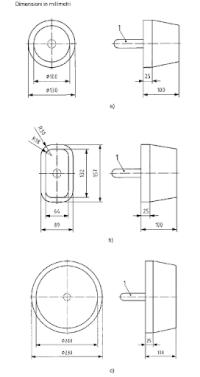
The templates used for this check are described in Appendix D (ref. UNI EN 1176-1:2024 D2.1)
Legend
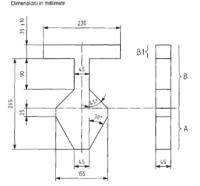
The templates used for this check are described in Appendix D (ref. UNI EN 1176-1:2024 D2.2)
Legend
This is a thermally modified timber with high added value and exceptional properties of resistance and durability, excluding the use of any chemical substances. Thermovacuum combines a highly energy-efficient vacuum drying process and heat treatment, with the aim of offering an ecological, low-environmental-impact, cost-effective, high-quality product. Thanks to this technology, it is possible to provide timber species with characteristics typical of tropical timbers — which are also imported for this reason — such as a strong aesthetic appeal and particular durability properties not found in natural wood, making it particularly suitable for outdoor use.
In case of contact with the ground, one or more of the following methods must be adopted: - use of timber species with sufficient natural durability in accordance with durability classes 1 and 2 of the natural durability classification provided in point 5.2 of EN 350:2016; - construction methods, e.g. post supports; - use of timber treated with wood preservatives in accordance with figure A.1 of EN 351-1:2023, and EN 335:2013, use class 4 (Situation where timber or wood-based product is in direct contact with the ground and/or with fresh water) (ref. UNI EN 1176-1:2024 point 4.1.3)
A closed, continuous tubular opening with a length such that it is necessary to walk on all fours or to kneel in order to pass through it. (ref. UNI EN 1176-1:2024 point 3.40). Tunnels must have a maximum length of 10,000 mm and must comply with the requirements indicated in Table 1 - (ref. UNI EN 1176-1:2024 point 4.2.7.4)
The standard provides guidelines for the design of parks and play areas for children and adolescents that contain play equipment. The objective is to increase the safety of such spaces in terms of installed equipment and to encourage the construction of adequately sized areas that are easily accessible from residential areas.
The standard consists of two parts. Part 1: Table tennis tables, functional and safety requirements, test methods. The standard specifies the functional and safety requirements for table tennis tables. Part 2: Net support assemblies - Requirements and test methods. The standard specifies the requirements for the permanent or temporary mounting of the net attached to the table tennis table in accordance with UNI EN 14468-1.
The standard applies to installations for users of in-line skates, roller skates (skateboards) or similar wheeled sports equipment, such as BMX bicycles. The aim of the standard is to specify the safety requirements that, to a large extent, protect users and third parties (e.g. spectators) from hazards when the installation is used as intended or as reasonably foreseeable.
The standard defines five use classes that represent the different service situations to which wood and wood-based products may be exposed. It also indicates the relevant biological agents for each situation. The differences between use classes are based on the differences in environmental exposure that may make wood or wood-based products susceptible to biological deterioration.
The standard provides guidance on methods for determining and classifying the durability of wood and wood-based materials against biological agents that degrade wood. It also provides information on predicting the service life of wood products and classifies different wood species according to their durability, allowing them to be selected for a specific use.
Equipment should be constructed so as not to create the following hazardous situations that could cause entrapment: a) tunnels in which children can crawl with their whole body; and b) heavy suspended parts or with rigid suspensions (ref. UNI EN 1176-1:2024 point 4.2.7.4)
A playground equipment on which children move along a cable using the force of gravity. Zip wires are regulated by UNI EN 1176-4:2019 and are distinguished into two different types: "suspension" type equipped with a suspension assembly that includes a handle for the user (rarely used) and "seat" type equipped with a suspension assembly that includes a seat (much more commonly used). (ref. UNI EN 1176-4:2019 point 3.1)
The length of the cable from the seat, C1, must be a minimum of 2100 mm, when measured as per figure 2, except that it may be reduced to a minimum of 1800 mm if the moving parts of the trolley are enclosed, not accessible to the user and there is no possibility of finger entrapment. (ref. UNI EN 1176-4:2019 point 4.13)
The fall space and impact area must be free of obstacles that could cause injury; they must provide a distance of at least 2000 mm on each side, when measured from the centre of the cable, and a distance of at least 2000 mm beyond the end of the swing position (maximum 45°, end stop compressed) of the handle or seat. The impact area may be reduced in width symmetrically from the end of the run to a minimum overall width of 2000 mm (see figure 4). The impact area must have an adequate level of impact attenuation, at least equivalent to a free fall height of 1000 mm. For fall heights greater than 1000 mm, the attenuation properties of the impact area must be increased proportionally. (ref. UNI EN 1176-4:2019 point 4.14)
The ground clearance is the distance between the underside of the seat or lowest point of the handle and the underlying surface. (ref. UNI EN 1176-4:2019 point 4.12)
For seat-type zip wires, rigid suspension elements must not be used. If a flexible suspension element is used, it must be designed to prevent any risk of strangulation. If a traction device is provided for the trolley, it must be designed to prevent the risk of strangulation. (ref. UNI EN 1176-4:2019 point 4.6)

23/06/2026 |
Read the full news10/06/2026 |
Read the full news

HOLZHOF S.R.L
Via Rupe 33, I-38017 Mezzolombardo (TN)
Tel. +39 0461 601 501 | info@holzhof.com | info@pec.holzhof.com
VAT No. 01762120226 - Tax Code 00458210218
